Monday, February 28, 2011

The Help by Kathleen Stockett

Last year,  The Help became the most requested interlibrary loan book that I have ever seen at our library, and now I get it. Our book club has read a lot of great books this year depicting race struggles both in the US and in other countries. Sometimes I kind of get bogged down by reading too much in a "theme" like this, but reading The Help was like a strong, cool spring wind that rushes you, taking your breath away: it takes you by surprise, is refreshing, and warns you not to get too comfortable because the bite of winter is not long gone.

The story unfolds through three different viewpoints, told in alternating sections. These three women represent three different perspectives on the issue of race in America in the early 1960's. Miss Skeeter is a budding writer who just wants to escape the small town where she grew up so that she can become the woman she knows she is inside. She has come home from college with a degree instead of a husband, something that her social-climbing friends just can't understand. Skeeter's mother doesn't help matters, always criticizing Skeeter's clothes, hair, and manner, making Skeeter an insecure mess. Aibileen is the maid for one of Skeeter's "friends" who has lost her only child and who loves the white children she is paid to tend. She is an intelligent, insightful woman who is trapped in a job much beneath her by her race and her race alone. Minny is Skeeter's very outspoken friend, also a black maid, who can't seem to keep a job because of her "big mouth" and pride. She is abused by her husband and loathed by the white ladies, but she finally finds a maid job with an unusual white woman who has come from a poor background in the South.

It is Miss Skeeter who brings all these characters together in a story within a story. She is asked by a New York publisher to write a book about the "colored" maids in her town, exposing their real lives to the world. At first Skeeter has a very hard time convincing any of the maids to come forward, jeopardizing not only their jobs by telling the truth, but their very lives which become threatened by whites who may seek revenge for the exposure to their lives and prejudices. It is Aibileen's struggle then, too, to help Miss Skeeter, who she initially mistrusts but grows to love. She wants desperately to tell her story, but she also wants it to mean something to all the other maids. She knows that their stories will be a tiny step in helping abolish segregation and injustices due to race.

Do these powerful women find their voice in the end? Does the book they write ever get published? Does the KKK seek retribution for their boldness? Does Miss Skeeter ever get out of her small town? Do Minny and Aibileen ever get a better life and is it everything they hoped? By the end of this beautifully told story, you will know all these answers, and I hope you will be as moved as I was.  I hope you will be moved enough to try to end prejudice where you see it in your life. Because it always takes the first person to say "No, this wrong!" before the right and truth can be found. 

Sunday, February 20, 2011

I am Number Four


So, yes, I am easily influenced by media, and when I saw the trailer for this movie, I had to read the book before I went to see it. I read the book, loved it, and now I'm iced in, locked in my house, and I may not even get to see the movie version. I'll try to console myself with the fact that it was a thoroughly enjoyable read.

The premise is this: The planet Lorien has been defeated by the merciless Mogadorians who pillaged Lorien for its natural resources. So only nine Lorian children escaped, along with their care-givers, to Earth where they had to separate and stay alive until their individual powers come to them. They can only be killed in numerical order because they are protected by "charms." These powers will help them to fight the Mogadorians and recapture their planet. But the Mogadorians not only want to wipe out the Nine, they also want Earth for its resources. So it becomes the mission of Number 4, now named John Smith, to learn to fight them, although his powers are still not fully developed.

Meanwhile, John just tries to hide in plain sight, going to school and being a "normal" teen. But on his first day in Paradise, Ohio, he gets in a fight with the most popular guy at school and falls for his girlfriend. Not a good way to hide.

All in all, this young adult title is a fun, sci-fi thriller full of great characters and lots of danger. The build up to the fight with the Mogadorians was very suspenseful, with the tension building up at a good pace. The ending, full of high-tech violence and much blowing up of aliens, got a bit long-winded for me, but most younger readers will probably enjoy it.   I hope I can get to the movie before it, like the Mogadorians, blows town.

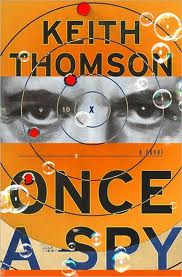
Once a Spy by Keith Thomson

When another librarian recommended this book, it sounded like a fun read, and she was so right! If you're ready for a fun yet thrilling spy/espionage novel by a new author, this one's for you.

Charlie Clark, a lazy gambler who really hasn't found himself yet at near middle age, always thought his father was an average, low income appliance salesman. But when he takes Drummond, who now suffers from Alzheimer's disease, home after a confused episode, Charlie starts to wonder. He is forced to wonder things like, "Gee, why is that guy pointing a gun at me, and how does Dad know how to kick his butt and get away?" and "Okay, why did my house just blow up and my dad grabs me like a super hero and throws us both out a window before we're fried." These things can only add up to one thing: Dad is a spy. A class A, undercover, knows lots of secrets kind of spy.

This may seem kind of cool and exciting to a guy whose life is only as lively as the next horse race, but it gets a bit tricky when a CIA operative gets Alzheimer's. He becomes a threat- a threat that needs to be eliminated.  And so the action begins. The father and son become a spy-fighting unit, complete with guns, stealth, and code-breaking expertise. Drummond's coherent moments seem to come at just the right time, and the two battle to try to find the person who isn't a bad guy who can help them out of their mess.

Thomson's thriller was a fun, surprising ride, and I can't wait for the sequel which comes out soon. So, give Once a Spy a try. It'll have you on the edge of your seat and looking over your shoulder. After all, anyone can be a spy, even dear old dad!

Thursday, January 27, 2011

Uncle Tom's Cabin by Harriet Beecher Stowe

This classic novel about slavery first published in 1852 is our February book club pick. But because we think of it as "classic" now, it's so easy to forget that publishing it was, quite simpy, an act of complete heroism during that time. While the flowery, abundant language of the time period was a bit difficult to get through compared to the brisk, no-nonsense style of writing of today, Uncle Tom's story is one that all Americans can learn from and keep in their hearts for all time.

While Uncle Tom's story is the center-point of the book, the stories of other slaves in many different kinds of circumstances are intermingled with his, giving the reader a sense that while everyone has a story, the basic, horrifying truth about slavery was universal. While some slaves may have been treated in a way that the "white folks" called "good" or "humane" the mission of all slaves, regardless of how they were treated, was simply to be free.


It was still shocking to me to read dialog between whites where they discussed how Africans didn't have souls; that they weren't really people at all. I know this is a novel, but I also know that it was based on cultural fact.  It's so difficult to believe that anyone could really believe such things, even if they did grow up that way, living in the South. How could you look at another human and say they are a dog instead? How could you observe the strong spirit of a person who was willing to endure anything just to live and keep their family, and say there really is no spirit there? 
Another interesting aspect of the book, which is very blatantly a plea by the author to put an end to slavery, is how much the Bible is quoted, and how much the issue is debated in terms of its relation to religion. Stowe pointed out that slavery in America was not the economic issue that farmers in the South wanted eveyone to believe, but a moral issue, and an issue that would affect your very salvation.

I have to say that reading the book, while not exactly enjoyable because of its length and wordiness, was well worth it because of its beautiful and moving story. It was a wonderful reminder to me to keep fighting for what I believe in. I know that I need to work to remove any prejudices that may remain within myself, and I also need to continue to try to help others see the blatant bigotry and unfairness that they impose on others and which they justify to themselves in various ways, especially through scripture. At the risk of sounding "preachy" here, I'm going to put myself out there with Harriet Beecher Stowe in her belief that to become a truly free America, we, if we are a religious people, need to stop interpreting the Bible to mean whatever we want it to mean in order to justify our prejudices. We need to look to the story of Uncle Tom and gain from it the knowledge that there are truly good people in the world, in all different circumstances, races, and lifestyles. Uncle Tom's message is that if you believe in and love God,  He will include you in His love no matter who you are; He does not discriminate.

The Maze Runner by James Dashner


In looking for the above picture for the blog, I ran across a film article that states that the director of the first Twilight movie, Catherine Hardwicke, will direct the film version of The Maze Runner! This is fantastic news, as many Twilight fans will tell you that there's just a great feel and indescribable addictiveness to that first Twilight that the others, while very good movies also, did not have. The other really great thing is that The Maze Runner is a wonderful young adult novel that will make a very exciting movie.

The Maze Runner is mostly the story of a boy named Thomas who arrives in some kind of mysterious elevator called "the box" and is dropped into a place called "The Glade." Thomas, like all the other boys who have been brought to the Glade in the past two years, cannot remember anything but his first name. But Thomas is a bit special, because he does have a feeling that he knows some of the boys and the single girl who shows up. He also has an strong, inner calling to become one of the maze runners, who daily go out to find a solution or way out of the huge stone maze that surrounds the Glade. The Maze walls move around at night, and lurking around every corner are bulbous, monster-creatures they call a "Grievers" who have horrible, half animal, half machine appendages to kill anything that come near them.  

The boys in the Glade also talk a bit differently, and this, to me was the only real weakness in the book. We are introduced to the idea that the boys have formed their own "slang" and dialect, but really all it is is a way for Rashner to include a lot of swearing and cussing without actually saying all those words that parents would object to. I call it "pseudo-swearing," and while I appreciate the idea of eliminating bad language in young adult books, it was used so much in The Maze Runner that it became distracting and felt unnecessary.

However, all the wonderful details about The Glade and the Maze make for an exciting book that really is about many ideas that are so important for people to develop for the survival of a community and a world:  the power of hope, the strength of the individual, and the even greater strength of working together to solve problems and having the courage to attack them at any cost. All-in-all what you get here is an exciting, easy-to-read novel that will appeal to a wide range of young people. Strong male and female characters abound, exciting action is throughout, and those messages about how we can train ourselves to overcome anything make for a fun read. For those of you who loved The Hunger Games, this book is for you! And luckily, there is also a sequel that I'm putting on my reading list called The Scorch Trials.

Saturday, January 15, 2011

The Twelfth Imam by Joel C. Rosenberg

     This is maybe one of the most difficult reviews I've done on my blog for various reasons. I started reading this book thinking it was a thriller - which I guess it is. I liked it in the beginning because it read like a thriller - which I suppose it is. Then, toward the middle or end, it started to get weird. It was kind of a weird that I personally laugh at, so it was kind of entertaining, but then when you think about other people reading it, it kind of scared me a little.
     It tells the story of a young man and his parents who escapes Iran with the help of an American embassy worker. They never tell their son of their perilous escape, and he goes on to live the American dream. He is an Iranian/American, living a mostly typical life. His father is a doctor, and he is a good student, but he always feels the pull of some darker past and gets in  trouble, despite his high intelligence. Wow - the making of a spy.
     And that is what David becomes. He is the master of many languages and infiltrates the Iranian "government" to try to stop the enriching of uranium which the US fears (and is right) will be used against Israel and then the states. It's a good plot with some great twists and good, engaging characters. And then it just gets weird, as I said.
     The reason for the title is that all the Iranians are waiting for the coming of the 12th Imam, which is like their Christ, who will come at the end of the world to save all devoted muslims and kill all infidels, namely the Israelis and Americans. And then he, who they also call the "mahdi" appears. Yup, he appears to some people, doing miracles and performing wonderful acts. So the muslim leaders who are in charge of the nuclear program in Iran, finally have him as a guest at their meeting, and he tells them to start annhilating the "infidels" as quickly as possible, and Allah will reward them. Yes, they think he just stands before them, a man, speaking at their meeting.
     If that's not weird enough, one of the  workers in the Iranian plant, a nonviolent muslim, has a car crash, and as he fumbles from his car, who does he come upon but . . .  yes, wait for it . . .  Jesus Christ. Whup, there  he is. Jesus himself appears to the man and tells him to not be afraid but there are false prophets around, and he needs to basically convert, and he'll be alright.
     Now, while I don't usually tell the ending in my reviews, I'd love to make an exception for this book. Oh, whoops, excuse me! There is no ending! No, nothing, nadda, no ending. And it's not even like, "ok, here's the ending that you have to fill in and wonder how to interpret it until you go to book club and discuss it" ending. This is an actual, and most dispised by Lisa, nonending. A more blatant set-up for the sequel has never existed. And that makes me mad. It's kind of like movies that in the end are like "Whoops! Just kidding- it was all a dream!" aka "Vanilla Sky" style. Ugh. GIVE ME A BREAK!
    Well, I'm almost done with my rant about how disappointing this book is before I start talking about religion and how disapointed I am in many people of my own Christian religion of late, and how this book actually should teach some people something about how we need to watch for false prophets and that each religion's Bible must be interpreted by many in order to get a handle on its meaning otherwise chaos in the form of world domination and extreme bigotry may occur. So, I'll get to the point of my mistake in reading this book. In the back it was recommmended highly by Rush Limbaugh, and on Amazon I REALLY should have read this disclaimer in a review - "Rosenberg laces his political speculation with evangelical Christian themes, which will bother those who like their thrillers unencumbered by the author’s political and religious beliefs." Yeah, that would be me.
   So, while I love people coming to check out books in our library, please pass this one up. But I love a good debate, and I believe everyone's opinion is valid. How about you?

Sunday, December 19, 2010

Mudbound by Hillary Jordan


I purchased Mudbound for the library some time ago, and I actually started reading it, but then I put it down because some new book that I'd been waiting and waiting for came out, and I just couldn't help it and had to read that one. Now, I wish I would have continued with Mudbound because it turned out to be a wonderful book full of carefully crafted characters thrown together  to create a compelling story of prejudice, love, family, and sacrifice. 

The book is told in alternating chapters from the points of view of Laura McAllan, her husband Henry, her charming brother-in-law Jamie, and a neighboring share-cropper's son named Ronsel Jackson. Laura is a woman in danger of becoming an old maid until she meets Henry, an aging war veteran with a limp and the deep desire to become a farmer. He drags Laura away from her family and friends and plops her on a piece of ground she aptly names "Mudbound" because of its general lack of appeal. Henry's brother Jamie eventually returns from war also, becoming the light in the muddy world for Laura and her little girls. Jamie also befriends Ronsel, a war veteran himself who struggles with life after war and after love. But because Jamie is the son of a southern, white, farmer, and Ronsel is the son of a southern, black share cropper, the friendship becomes the center point for conflict both within and without the families. All these characters at some point have to deal with Jamie and Henry's volatile, ultra-prejudiced father, Pappy, who tries to rule the roost that Laura tends to, and who loves to stir up any trouble he can simply to have something to do.

This mix of characters along with the intermingling issues of prejudice, race, sibling rivalry, and farming as a lifestyle all make for a fabulous read. Reading Mudbound was a shocking look at how many Americans seem to love prejudice and feeling superior to others. Although I'd like to think much of this kind of deep ignorance has been wiped out by societal pressure, good leadership, and conscience, I know that, in reality, it still exists. People (and I include myself at times) hide their prejudices behind things like religion or law, saying that there are rules, and we simply have to follow them because someone wrote them down for us and interpreted them for us. To accept rules that are unjust or inhumane simply because they are written seems supremely ignorant to me. After all, segregation rules were law in this country at one time. Where would our country be if no one stood up against the injustice? There are still religions where women can have very limited roles or no role at all because they are inferior beings in the eyes of God. Now, I'm not saying we can be lawless or usurp the law anytime we want to, but when we see injustice, it needs to be challenged. People are people, equals in their rights to humanity and Mudbound does an excellent job of illustrating this in vivid writing and voice.

I encourage you to read Mudbound for a lesson in prejudice, freedom, equality, and good writing. Enjoy!

The Giver by Lois Lowry


The Giver is a book some say that everyone should read. It's a book that brings up ideas of what life could be like if mankind gave up on certain ideas that so far most people believe are essential. Ideas like personal freedom, creativity, and human rights are nonexistant in the world of The Giver. What would life be like without these most basic things? Well,  Lowry tries to tell us in her novel.

This is the story of Jonas, a 12-year-old boy who is chosen to be the receiver of all the memories of all the ages. The Giver is an old man who has held these memories for the people so that they do not have to experience things like war, illness, loneliness, greed, or many other unpleasant, painful emotions and physical weaknesses. But by taking away memory for all, this also means that the Giver is the only one who holds the good memories, too; memories of pleasure such as sledding down a hill on a wintry day, feelings of love and companionship, feelings of joy or success. All of these have been given up by the people for all time so that their society can be "happy" and "productive" without any conflict whatsoever. Jonas, then, is to be the new holder of all of this, good and bad. The question becomes this: once Jonas knows the fundamental truths of life, such as how the people of this community are "released" from society, can he handle it? Will he see utopia as just that, or will he wish to put back all the memories so that the people can once again feel all that there is, and be all that they can be?

Lowry's book is a fascinating study in society that made me eternally grateful for things like free will, democracy, religion, individual creativity, and the joy that can come from daily living. In Jonas' world, people can't even see in color, their job is chosen for them, they don't choose their own clothes, and they don't keep their own babies to raise. There really is nothing except for the community and its ongoing peacefulness. When someone loses his usefulness or is not seen as a good addition to the community, they are "released" by the others.

Some find the book too ambiguous because it does leave almost everything up for interpretation. This didn't bother me too much until the end. The ending, too, is ambiguous, and this always bothers me a lot. I like a novel to "end." I like to sit and wonder about characters and places, but I don't like to wonder about what the author thinks happens to them. The author should know, right, so why can't she tell us?

To me, the big question in the book is this: If we know nothing of pain or sorrow, can we really feel joy to its fullest? If there is no evil, can we clearly see the good in people? If the plan is a contant status quo, can there ever be improvement? My answer to all of these is "no." What would your answer be?

Sunday, November 21, 2010

The Bourne Identity by Robert Ludlum

     A friend of mine told me years ago how she loved the Bourne books by Ludlum so much, that she kept them by her bedside and would read them over and over. She told me that if I loved the show "Alias" as much I did, I would love them. But I never went to pick them up. So, recently, I decided it was time, and I was not disappointed.
     You may think you know the story of Jason Bourne because you have seen the blockbuster movies with Matt Damon. Think again. Many people have told me that the books barely resemble the movies, and they were so right! While the general premise that Jason is hurt, found on a ship and nursed to health, only to find he has one heck of a case of amnesia, is all intact, that is where all similarities between the book and movie stop. In this complicated espionage thriller, the plot to destroy Bourne is not just undertaken by the government agency he worked for, it's perpetrated by many other criminal aspects as well, most especially by a notorious assassin named Carlos. All Jason remembers is that he is a killer and that he must kill Carlos, even though he has no idea who that really is or who, he himself, really is.
     The people and places in the plot swim smoothly together, creating a huge web of mystery, and you question your logic at every turn. The only thing I really disliked in the book was the woman love interest, Marie, who is so unlike the sexy, unfortunate woman that Bourne borrows the car from in the movie, that it was pretty distracting to me at times. The Marie in the book, while extremely intelligent and loyal, seemed too much like a '70's romance novel heroine to me. The romantic dialog between she and Bourne seemed very forced, and pretty unoriginal. "Oh, Jason,  my love, I can't bear to live without you," and that kind of thing. While the whole exciting plot kept me on the tips of my toes, holding my breath, I would then sigh when Marie would say this kind of inane drivel and think, "Geez, Jason, can you just dump her for someone with a little more savvy?" I so love the tattooed girl with the choppy hair and broken down car in the movie, that I just kept wishing it was her at Jason's side in the book.
   But that is a small flaw in a wonderful thriller full of detail and twists and turns. While I enjoyed The Millenium trilogy more, the Bourne books are classics in the thriller genre. So, don't be a late bloomer like me, and pick up a Bourne today!

Mockingjay by Suzanne Collins

     Ugh! How can it be over? I hate it when I'm done with a wonderful series like this one and there just seems to be nothing to read afterwards. This third book in the Hunger Games trilogy, while slightly darker than the rest, was a satisfying end to the story, even though I'm always left wanting more.
    Beginning right where Catching Fire left off, Katniss recovers from the Quarter Quell competition, finding herself in a hospital deep inside District 13. This is the district that the Capitol obliterated once upon a time, but as it turns out, there were survivors who went underground, literally. While you may think they just want to live in peace in their new underground world, District 13 is also filled with rebels who want nothing more than to defeat the Capitol and free Panem for good. Their plan? To promote the survival of the "Mockingjay" and use her as a symbol to the people, urging them to rise up and fight in a revolution.
     But what of Peeta? What about the other tributes we have come to love and hate in equal measure, and Katniss's beloved Gale? Well, they are all here in Mockingjay, each playing a role in the rebel plan. But Peeta did not escape the Capitol like the others, being used as well as the Capitol's symbol of power, urging Katniss to give up the rebel cause. Is he for real? Is he really on President Snow's side, or does he continue to try to save Katniss from afar?
   While I found Mockingjay to be quite sad and dark throughout, it's that sadness and desperation that lend reality to the fantasy world of Panem. If, indeed, our own country were taken by the government and turned into a sort of Communist state, wouldn't mankind be disheartened? Would we fight with everything we have to be free again? Of course we would.
     The thing I found the most disheartening, though, was that the leaders of District 13, while having the right ideals and the right end game in their hearts, were just as ruthless and politically minded as those in the enemy camp, the Capitol. It's just one more realistic train of thought within the novel; we need to be careful of our leaders, no matter what type of institution they lead. There are corrupt people in all walks of life, in every group and geographic area, in every religion and political party. It is our job to question logically what is right and what is wrong, no matter what our leaders say. Like Katniss, we should understand our own personal weaknesses, acknowledge them, and let others with better knowledge and skill fill in the gaps. But when we know what is truly right, we have to follow our own moral compass and step into the arena and fight for what's right, which ultimately is our freedom.